


Reverse Osmosis System (RO) for the small and medium-sized water store, bottling plant or other commercial application we offer high performance light commercial or industrial reverse osmosis systems, as well as bottled water equipment.
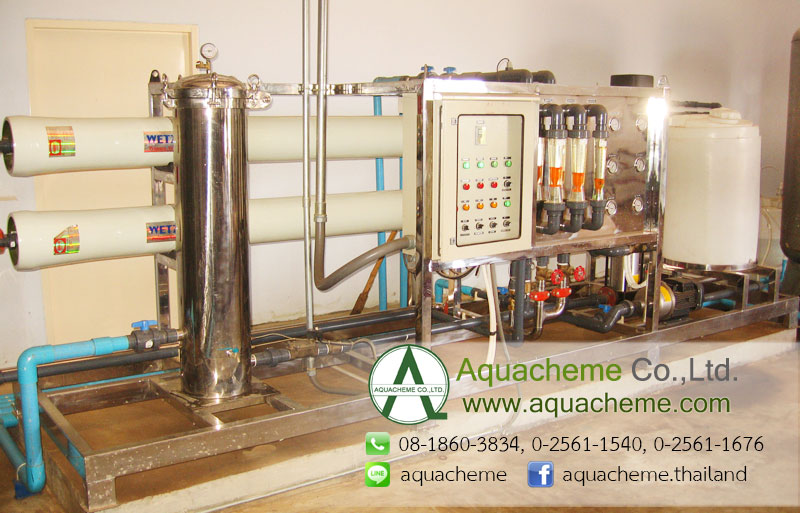
Aquacheme RO Systems are designed for higher recovery rates, minimum energy consumption, continuous commercial duty, and ease of use. Easy maintenance and operation. Aquacheme RO Systems have all of their components strategically located for easy access and inspection.
Why use Reverse Osmosis purification?
Industrial customers have their important reasons why. Certain home owners will get real benefits if their water supply is nasty, objectionable. questionable, or polluted.
Reverse Osmosis is currently the highest single technology available for “full spectrum” water purification from organic contamination and inorganic contamination such as toxic metals, many different salts, toxic salts (such as nitrates, metallic salts, and cyanides), as well as all kinds of particulates, asbestos, PCBs, pesticides, herbicides, drug metabolites, and even microrganisms. (Always add UV Disinfection of you have a problem with microorganisms.)
Carbon filtration alone does not remove inorganic contamination (when present) effectively, which is where Reverse Osmosis excels. On the other hand, Reverse Osmosis is a much more “fussy” technology compared to carbon filtration, and requires that you take a close look at your water chemistry to see see if you have any water quality issues that will foul the RO Membrane. Reverse Osmosis also requires a certain amount of pressure in order to work.
Reverse osmosis separation technology is used to remove dissolved impurities from water through the use of a semi-permeable membrane. RO technology involves the reversal of flow through a membrane from a high salinity, or concentrated solution to the high purity, or “permeate”, stream on the opposite side of the membrane. Pressure is used as the driving force for the separation. The applied pressure (P) must be in excess of the osmotic pressure of the dissolved contaminants to allow flow across the membrane.
Reverse osmosis (RO), also known as hyper filtration, is used by our Commercial & Industrial Brackish Water & Seawater Reverse Osmosis Systems to purify water by removing salts and other impurities. It is also capable of rejecting bacteria, sugars, proteins, particles, dyes, and other constituents that have a molecular weight of greater than 150-250 daltons.
Aquacheme, manufactures a full line of seawater desalination systems designed for heavy or continuous duty service in the marine applications where quality and dependable performance are keys. Our standard Brackish Water Reverse Osmosis systems are available with capacities ranging from 250 GPD to 500,000 GPD, and our standard Seawater Reverse Osmosis systems or water makers or RO desalination systems are available with capacities ranging from 380 GPD to 180,000 GPD. Aquacheme is also capable of manufacturing custom built Reverse Osmosis plants.
Municipalities and industrial facilities are able to use RO permeate as a consistently pure drinking water supply and to transform drinking water to high purity water for industrial use at microelectronics, food and beverage, power, marine and pharmaceutical facilities.
Unique source for your water purification needs:
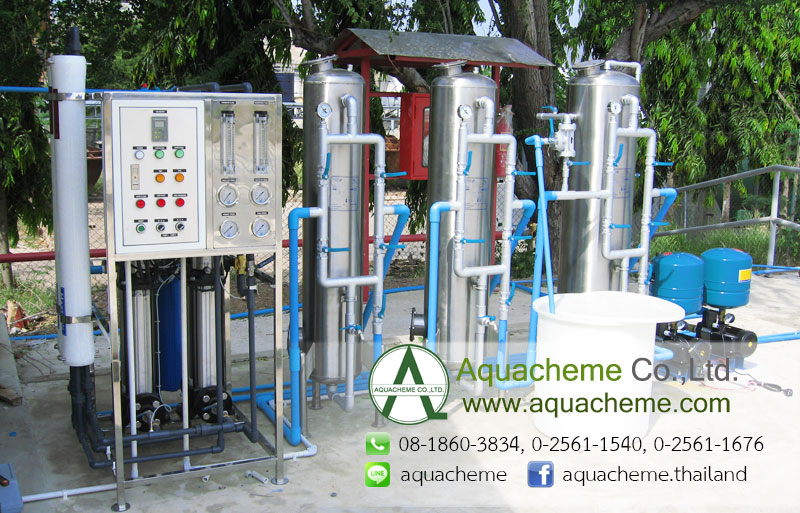
Reverse Osmosis systems from Aquacheme deliver high performance at the lowest life-cycle costs. Our pre-engineered systems are built with high-quality components designed specifically for water purification. They arrive at your facility ready to run with all filters, membranes, pumps, piping, controls and operating manuals.
We supply membrane elements, valves, filters, pumps, nanofiltration and ultrafiltration equipment and other components. Aquacheme is also unique in design and operation of these units. We build the complete machine, but Aquacheme Co., Ltd. stock all major RO systems components, such as membrane elements, controls, filters and high pressure pumps.
With expertise of Aquacheme, you will receive economical solution that creates value for you while reducing your operating costs for reverse osmosis systems.
If your business is in Thailand, Aquacheme will come to your site to do a site survey. In the site survey, we will examine the installation site, the water quality and the intended use for the water. This will give us the information needed to design the proper system and give you a cost estimate, including installation and maintenance.
Aquacheme’s Reverse Osmosis System is easy on your budget. We have installed systems for hotels, resorts, industrial processing, and other commercial applications, and we look forward to designing a system to meet your particular needs.
To find out more about how Aquacheme can help you with your special water quality needs, contact Aquacheme for further assistance with all your Reverse Osmosis needs. We will be happy to assist you.